
By Stephen Ledwith April 14, 2026
A year ago, the conversation around AI in the workplace was still largely theoretical for many organizations. Leaders were asking “should we adopt AI?” Today, that question is obsolete. The real questions are: How fast are you moving? And do you have a strategy — or are you just reacting?
We’ve crossed a threshold. AI is no longer a pilot program or a productivity experiment. It’s embedded in how work gets done — from how software is written, to how decisions get made, to how teams are structured. And the gap between organizations that are moving deliberately and those that are stumbling forward is widening fast.
Here’s what’s actually happening on the ground in 2026, and what it means for leaders who want to stay ahead of it.
The Shift from AI Tools to AI Agents
The biggest change in the past 12 months isn’t a new model — it’s a new mode of operation. We’ve moved from AI as a tool you prompt into AI as an agent that executes.
Agentic AI systems don’t just answer questions. They plan, take action, use tools, and complete multi-step workflows autonomously. Think of the difference between asking someone for directions and handing them the wheel. That’s the shift happening right now in enterprise software, operations, and even strategic planning.
I’ve seen this firsthand in engineering organizations. Teams that used to take days to complete routine development tasks — writing tests, reviewing code, drafting documentation — are now compressing that work into hours. Not because developers got faster, but because AI agents are doing the scaffolding work while humans focus on the judgment calls.
The organizations winning right now are the ones who figured out which decisions require human judgment — and offloaded everything else.
What’s Actually Changed in the Last Year
🤝 AI is Becoming a Teammate, Not a Tool
The mental model shift matters. When you treat AI as a tool, you use it when it’s convenient. When you treat it as a teammate, you design workflows around its capabilities — and you get dramatically better results. The best teams I work with have stopped asking “can AI help with this?” and started asking “why are we doing this manually?”
💻 Software Development Has Been Fundamentally Altered
This one is real and it’s permanent. AI coding assistants aren’t just autocomplete anymore. They write full features, catch architectural issues, generate test suites, and explain legacy code. Developers who use these tools well are outperforming those who don’t by a significant margin — and organizations that have embraced AI-assisted development are shipping faster with smaller teams.
The implication for engineering leaders is significant: headcount planning, skill hiring, and team structure all need to be re-evaluated in light of this.
Routine Knowledge Work Is Being Handled by AI at Scale
Data analysis, report generation, contract review, customer service triage, compliance monitoring — roles that were once considered safe from automation are now being augmented heavily, or replaced outright. This isn’t a future risk anymore. It’s a present reality in industries from financial services to healthcare to real estate.
⚖️ Governance Has Become Unavoidable
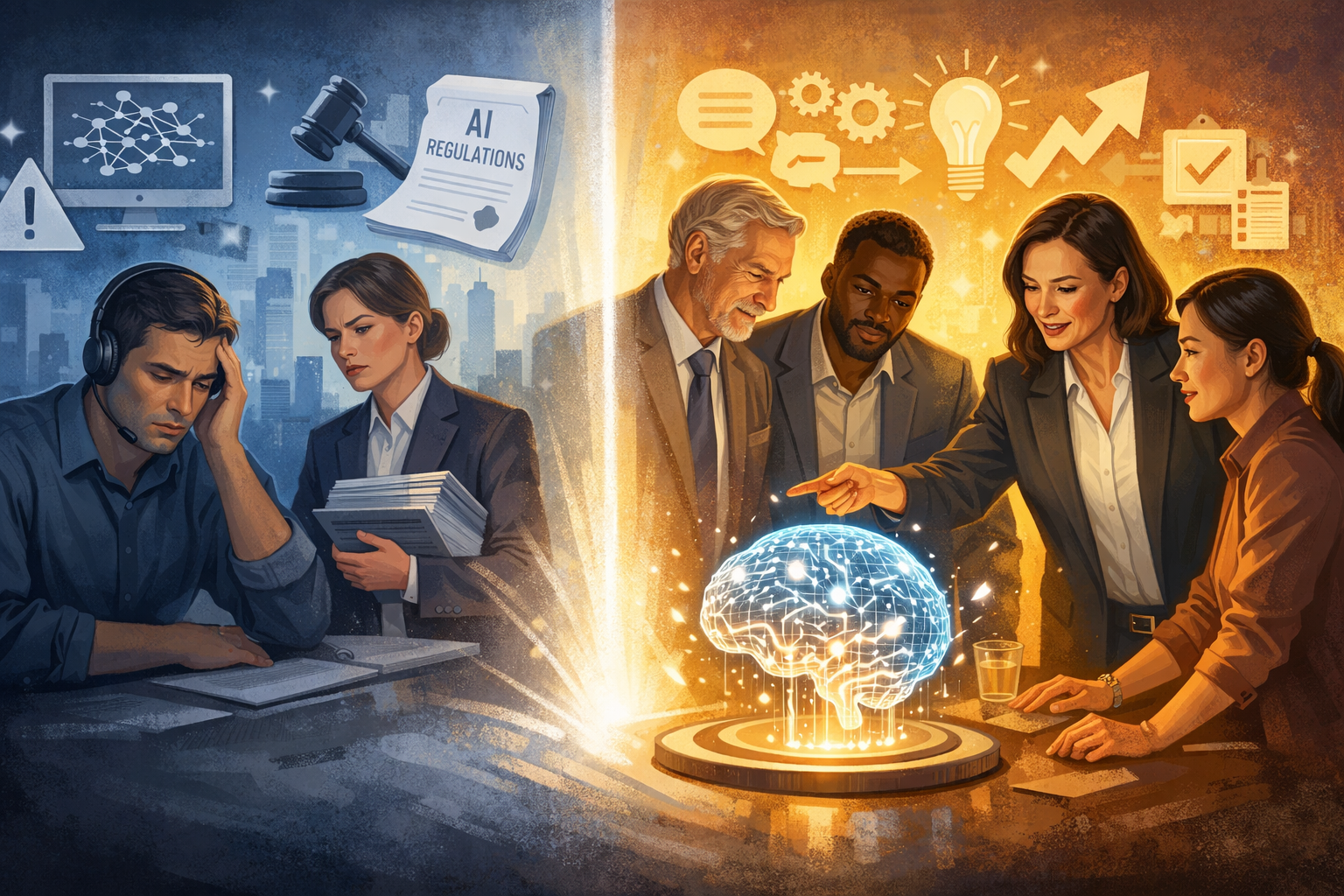
The “move fast and figure it out later” window has closed. Regulators, boards, and customers are all asking harder questions about how AI is being used, what data it’s touching, and who is accountable when it makes a mistake. Companies that built AI strategies without governance frameworks are now paying the price in legal exposure, reputational risk, and rework.
The Workforce Is Bifurcating
Here’s the uncomfortable truth leaders need to sit with: the workforce is splitting into two groups — those who can work effectively with AI, and those who can’t. And the distance between those groups is growing.
The people who are thriving aren’t necessarily the most technical. They’re the ones who:
- Know how to frame a problem clearly enough for AI to solve it
- Understand where AI output needs to be verified and where it can be trusted
- Are comfortable iterating and refining rather than waiting for perfect instructions
- Treat AI as a thought partner, not just an execution engine
This has major implications for hiring, performance management, and how you think about talent development. AI literacy is the new baseline competency. If you haven’t started building it into your people strategy, you’re already behind.
What Leaders Must Do Right Now
1. Audit Where AI Is Already Operating in Your Organization
Most leaders I talk to are surprised to learn how many AI tools their teams have already adopted without formal approval. Shadow AI is everywhere. Before you can govern it, you need to know where it is. Start with an honest inventory.
2. Define the Human-in-the-Loop Policy
Not every decision needs a human. But some absolutely do — and your team needs to know which is which. Define clear boundaries: what AI can execute autonomously, what requires human review, and what requires human decision-making. This isn’t just a risk management exercise. It’s how you build trust in AI-assisted workflows.
3. Restructure Teams Around Outcomes, Not Headcount
If you’re still measuring team productivity the same way you were three years ago, you’re measuring the wrong things. A team of five with strong AI integration can outperform a team of fifteen that’s operating the old way. Start asking what outcomes you need and work backward — don’t assume the same structure still makes sense.
4. Invest in AI Fluency, Not Just AI Tools
Buying more AI software without investing in how your people use it is a fast path to wasted spend and frustrated teams. The ROI on training and enablement is high. Build AI fluency across your organization — not just in engineering or IT, but in operations, finance, HR, and leadership.
5. Build a Governance Framework Before You Need One
Waiting until there’s an incident to think about AI governance is like waiting until there’s a fire to think about sprinklers. Build the framework now: data access policies, model accountability, audit trails, and escalation paths. It’s not glamorous work, but it’s what separates organizations that scale AI sustainably from those that create liability.
The Hard Question
Every leader I work with eventually asks some version of the same question: Is AI going to replace my team?
My honest answer: not wholesale, not soon — but it will replace specific roles, specific functions, and specific ways of working. The leaders who are thinking clearly about this aren’t asking whether it will happen. They’re asking how to guide their teams through it — how to be transparent about what’s changing, how to invest in people who are willing to adapt, and how to build organizations that remain human-centered even as automation deepens.
That’s not a technology challenge. It’s a leadership challenge.
Where This Is Headed
By the end of 2026, I expect:
- Autonomous AI agents handling entire business workflows end-to-end in early-adopter organizations
- AI governance regulation tightening in financial services and healthcare, with more sectors following
- A growing talent premium for people who can design, manage, and evaluate AI-driven systems
- A reckoning for organizations that treated AI adoption as a checkbox rather than a strategic transformation
The window to build a real AI strategy — one grounded in your business model, your workforce, and your risk tolerance — is still open. But it’s not going to stay open much longer.
AI is not waiting for your organization to be ready. The question is whether you’re going to lead the transition — or manage the fallout.
If you’re thinking through what this means for your team or your technology strategy, I’d like to have that conversation. Let’s connect.